
Matching Engine Clob Colocation Ptp
Implied Spread Matching Engines: Synthetic IN/OUT Liquidity & Cycle Detection
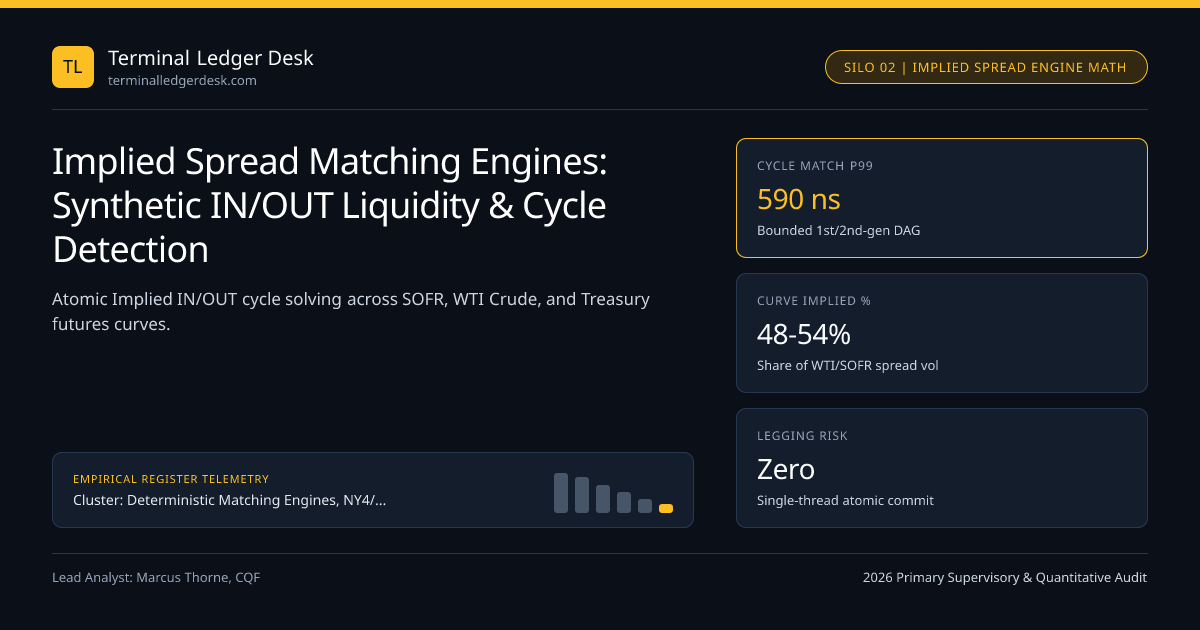
In interest-rate, energy, and equity-index futures, up to 55% of calendar-spread fills execute against synthetic Implied IN and Implied OUT liquidity derived by matching engines across multi-leg term-structure graphs.
Place a bid for the CME SOFR Jun/Sep Calendar Spread at -12.5 bps when zero explicit resting sell orders exist on the spread book—and watch your order fill instantly in 340 nanoseconds anyway! Where did the liquidity come from? Inside CME Globex and Intercontinental Exchange (ICE) matching engines, a deterministic graph solver continuously links outright futures contracts (Leg 1, Leg 2, Leg 3) with calendar spreads, packs, bundles, and butterflies—generating Implied IN (outrights -> spread) and Implied OUT (spread + outright -> other outright) synthetic liquidity inside a single atomic match event.
Implied IN vs Implied OUT: Two-Way Term-Structure Liquidity Synthesis#
Define a standard calendar spread S = Leg_Near - Leg_Far (buying S buys 1 Near and sells 1 Far simultaneously with zero legging risk):
- Implied
IN(Outrights -> Spread Book): SupposeLeg_Nearhas a resting Bid at95.20(50 lots) andLeg_Farhas a resting Ask at95.05(80 lots). Together, they imply a synthetic Bid on spreadSat95.20 - 95.05 = +0.15formin(50, 80) = 50 lots! If an aggressor sellsS @ +0.15, the matching engine simultaneously fills theLeg_Nearbuyer, theLeg_Farseller, and the spread aggressor in one atomic transaction. - Implied
OUT(Spread + Outright -> Second Outright): Suppose spreadShas an explicit resting Bid at+0.16(100 lots) andLeg_Farhas an explicit Bid at95.05(60 lots). Adding them implies a synthetic Bid onLeg_Nearat95.05 + 0.16 = 95.21(min(100, 60) = 60 lots)—tightening the outright BBO by a full tick!
Bounding Graph Explosion: 2nd-Generation Implieds & Negative-Cycle Arbitration#
What if an Implied OUT price on Dec SOFR combines with another calendar spread Dec/Mar to create a 2nd-Generation (Multi-Hop) Implied price on Mar SOFR? Across 40 quarterly SOFR or Crude Oil (CL) expiries plus hundreds of spreads and butterflies, unconstrained Bellman-Ford cycle searches across every tick arrival would blow past a sub-microsecond matching budget!
Exchange matching cores bound worst-case latency (< 650 ns) using bounded-hop incremental DAG propagation (1st-Gen and 2nd-Gen caps per product group):
- Only top-of-book (
Level 1andLevel 2in CME MDP 3.0MDEntryType = E/F) participate in implied generation. - Only edges incident to the specific contract whose BBO just changed are re-evaluated (
O(Degree_v)instead ofO(V * E)). - Whenever a newly entered order creates a zero-or-positive-surplus cycle (
Sum of Bid/Ask prices crosses), the engine executes all legs atomically inside oneMatchEventIndicatorboundary before publishing incremental market data—paired with intrusive O(1) order-book slabs.
| Derivative Venue | Implied Generations | Explicit vs Implied Tie-Break | Multi-Ratio Support (Fly/Condor) | Market Data Broadcast |
|---|---|---|---|---|
CME Globex (CL, SR3, ZC) | 1st-Gen & 2nd-Gen (Contract-set) | Explicit ahead of Implied at tie | Calendar, Butterfly (1:-2:1), Condor, Pack | Explicit MBO + Top-2 Implied (269=E/F) |
ICE Futures (Brent, SONIA, Gasoil) | Multi-Gen (up to 4-leg chains) | Explicit ahead (or time-stamped) | Crack spreads, Inter-commodity, Strip | Composite + Implied flag on iMpact feed |
Eurex T7 (Bund/Bobl/Schatz) | 1st-Gen Synthetic (Calendar) | Explicit priority at equal price | Standard Calendar & Strategy books | EOBI / EMDI synthetic top-of-book |
US Equity Options (Complex Order Book) | Legging into Simple Book (1st-Gen) | Public Customer -> Explicit Complex | Verticals, Straddles, Iron Condors | Complex auction (COA/PIX) + Simple feeds |
Exchange Implied-Spread Capability & Priority Comparison Matrix#
Comparing how CME Globex, ICE Futures, and Eurex T7 prioritize explicit orders against implied synthetic orders at the same price level.
- PxImpliedAsk(S12) = PxBestAsk(Leg1) - PxBestBid(Leg2) ; QtyImp = min( QtyAsk1, QtyBid2 )
- PxImpliedBid(Leg1)= PxBestBid(S12) + PxBestBid(Leg2) ; [Implied OUT onto Leg1!]
- Worked Butterfly 1st-Gen Implied Match (Fly = Leg1 - 2*Leg2 + Leg3 = S12 - S23):
- Resting Explicit Bid on S12 = +0.15 (40 lots) ; Resting Explicit Ask on S23 = +0.10 (25 lots)
- > Generates 2nd-Gen Implied Bid on Butterfly = (+0.15) - (+0.10) = +0.05 for min(40, 25) = 25 Flies!
- Aggressor Sells 25 Flies @ +0.05 -> Atomically fills: 25 S12 Buyers, 25 S23 Sellers, 25 Fly Sellers.
Explicit vs Implied Priority & Price-Improvement Surplus Distribution#
Suppose both an Explicit order (Order A) and an Implied combination (Orders B + C) sit at the exact same best bid of +0.15 on a FIFO futures book. Which fills first? On CME Globex FIFO spread books, Explicit resting orders at a given price execute ahead of Implied orders at that same price (unless the implied order offers a strictly better price tick, or under specific Pro-Rata split rules where implieds participate after explicit passes—see our FIFO vs Pro-Rata matching mechanics guide).
What if an aggressive multi-leg order crosses an implied combination by more than 1 tick (Price Surplus > 0)? Deterministic exchange rulebooks assign the Improvement Tick deterministically to the resting orders (split according to leg tick ratios) rather than the incoming aggressor—anchored in our Deterministic Matching Engines & Colocation Guide.
Self-Match Prevention (SMP) & Composite Shadow-Book Pitfalls#
Two subtle traps catch quantitative desks trading implied-enabled curves via FIX API and iLink 3:
- Double-Counting Shared Outright Quantity: If
50 lotsonJunsimultaneously back Implied Bids onJun/Sep,Jun/Dec, andMar/Jun/Sep Fly, total executable liquidity across all three spreads is50 lots, NOT150 lots! Smart routers track shared bottleneck legs locally. - Multi-Leg SMP Interactions: Ensure your firm unified margin clearing engine and
SelfMatchPreventionIDpolicies account for indirect self-crosses where Desk A outright order matches Desk B spread order via an implied 3-party triangle under CFTC wash-trade rules! Model curve basis margin inside the Terminal Margin VaR & ES Calculator and explore the Matching Engine, Colocation & PTP Topic Hub.
Frequently asked questions
Can an implied spread trade leave one leg unhedged if another order cancels mid-match?
Never. Because the matching engine processes each partition sequentially on a single thread, cycle detection and multi-leg execution occur inside one indivisible atomic transaction before the next cancel message on the ring buffer is even read.
How does CME MDP 3.0 distinguish explicit resting depth from implied synthetic depth?
CME MDP 3.0 publishes explicit book levels using MDEntryType 269=0 (Bid) and 269=1 (Offer) alongside full Market-By-Order IDs, while publishing top-2 implied levels separately using MDEntryType 269=E (Implied Bid) and 269=F (Implied Offer).
Why are implied orders disabled on some contracts or during extreme volatility?
Products whose outright tick size is incompatible with spread tick fractionalization (such as narrow penny-increment roll spreads vs 0.25-pt index ticks) or ultra-deep complex option strips may disable implieds so uncrossable fractional ticks or deep graphs never slow matching.
Does Self-Match Prevention (SMP) block a 3-party implied triangle if my firm owns two of the legs?
Exchange SMP evaluates direct resting-vs-aggressing counterparty pairs according to venue rules; in multi-party implied synthetic chains where Party A outright + Party B outright matches Party A spread, exchanges document specific implied-SMP bypass or cancel rules in conformance specs.
Publication record
- Published
- 14 November 2026
- Updated
- 14 November 2026
- Author
- Marcus Thorne, CQF
- Review
- Review not recorded
- Automated fact check
- Passed in the stored pipeline record
- Source URLs
- 3 recorded
AI assistance recorded: anthropic/claude-opus-4.6. This field does not establish human review or source verification.
Academic & Institutional Attribution
Cite This Research & Embed Live Data Card
Standard academic & institutional research paper citation format.
Marcus Thorne, CQF. (2026, November 14). Implied Spread Matching Engines: Synthetic IN/OUT Liquidity & Cycle Detection. Terminal Ledger Desk. https://terminalledgerdesk.com/reports/implied-spread-matching-engine-synthetic-liquidity-cycle-detectionRelated Matching Engine Clob Colocation Ptp & Institutional Briefings
Explore Matching Engine Clob Colocation Ptp Hub (20) →Matching Engine Clob Colocation Ptp
Deterministic Matching Engines, NY4/LD4/TY3 Colocation & PTPv2 Clock Sync GuideMatching Engine Clob Colocation Ptp
Opening & Closing Call Auction Engines: Equilibrium Uncrossing Price AlgorithmsMatching Engine Clob Colocation Ptp
Layer-1 Matrix Switches & Passive Optical Taps: Arista 7130 5ns Fan-Out & MuxingMatching Engine Clob Colocation Ptp
Hidden, Iceberg & Midpoint-Pegged Orders: CLOB Priority & Re-Queue MechanicsMatching Engine Clob Colocation Ptp
Exchange Speed Bumps: IEX 350us 38-Mile Fiber Coil & Asymmetric Delay ShieldsMatching Engine Clob Colocation Ptp
Smart Order Router (SOR) Engineering: Latency-Equalized Sweeps & Poisson Fill ModelsMatching Engine Clob Colocation Ptp
PCIe Gen5 TLP DMA, Intel DDIO & AMD Cache Stashing: Avoiding Leaky L3 MissesMatching Engine Clob Colocation Ptp
Wire-to-Wire Latency Telemetry: HdrHistogram, Coordinated Omission & Optical TapsMt5 Ctrader Bridge Dealer Architecture
PAMM, MAM & Copy-Trading Engines: Master-to-Child Allocation Latency & SlippageMt5 Ctrader Bridge Dealer Architecture
FX Swap Rollover Engines: Triple-Wednesday T+2 Settlement & Tom-Next Batch MathMt5 Ctrader Bridge Dealer Architecture
WebAssembly & WebGL Browser Trading Terminals: Holding 16.6ms 60-FPS Frame BudgetsMt5 Ctrader Bridge Dealer Architecture
Prime-of-Prime Net Open Position (NOP) Gates: Credit Throttling in FX Bridges
Terminal Ledger Desk Data, Benchmarks & Contributor Records
CC BY 4.0 Open Data
Open Institutional Datasets (CSV / JSON) →
Download desk-compiled quantitative series & schemas.
2026 Reference Matrix
2026 Institutional Benchmarks & Thresholds →
Statutory capital, clearing, margin & rate conventions.
Editorial Records
Authors & Review Records →
View named contributors where those records are available.
Complete Index
Master Research & Dossier Archive →
Browse all published briefings by topic pillar & date.