
Matching Engine Clob Colocation Ptp
MiFID II RTS 25 & FINRA CAT Clock Drift Audits: 100us HFT Traceability Compliance
European MiFID II RTS 25 mandates <=100 microsecond maximum UTC divergence and <=1 microsecond timestamp granularity for high-frequency algorithmic traders, backed by annual NIST/NPL traceability reviews and continuous drift alerting.
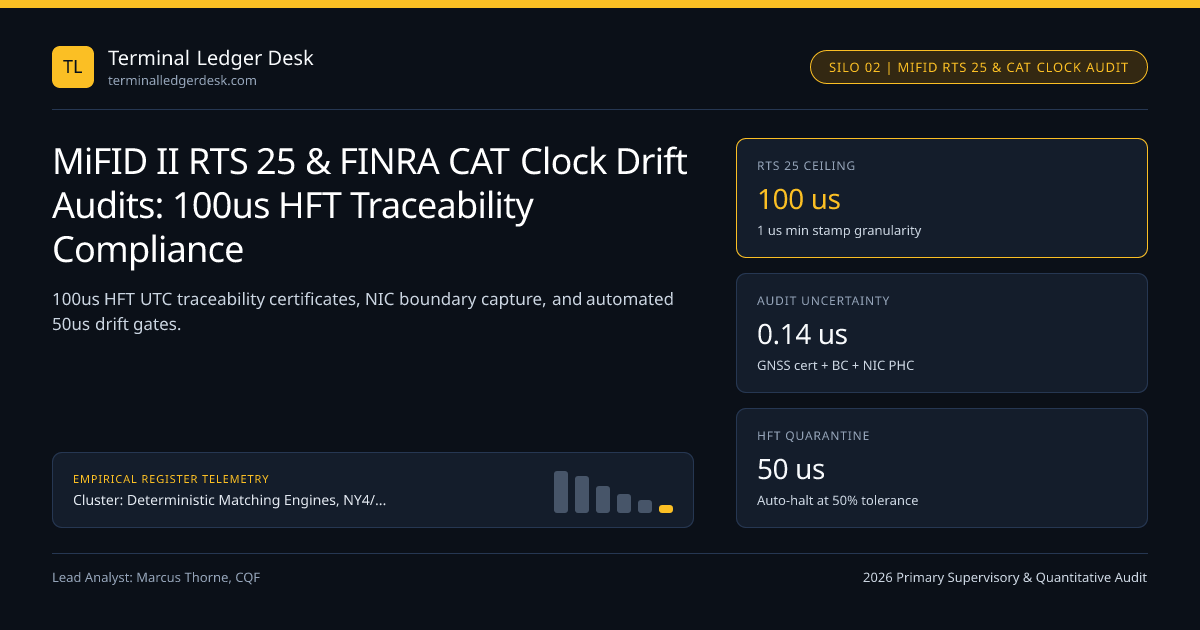
Synchronizing trading servers with IEEE 1588v2 PTPv2 is only half the institutional mandate—proving unbroken metrological traceability to UTC during a regulatory inspection by the UK FCA, BaFin, ESMA, or FINRA is where compliance audits succeed or fail. Under Commission Delegated Regulation (EU) 2017/574 (MiFID II RTS 25) and US Consolidated Audit Trail (SEC Rule 613 / FINRA Rule 4590), algorithmic trading firms must document every optical cable delay, PTPservo offset log, and out-of-tolerance alert threshold across an immutable multi-year archive.
MiFID II RTS 25 Annex Table: Matching Gateway Latency to Clock Tolerance#
Unlike older flat rules, MiFID II RTS 25 ties both Maximum Divergence from UTC and Timestamp Granularity directly to the trading venue gateway-to-gateway latency AND participant activity type:
- Trading Venues (
Gateway-to-Gateway <= 1 ms— Eurex, LSEG, Cboe EU, LMAX): Maximum UTC divergence<= 100 microseconds, timestamp granularity<= 1 microsecond(YYYYMMDD-HH:MM:SS.ssssssor nanoseconds...sin FIX 5.0 SP2). - High-Frequency Algorithmic Trading (
HFT) Members: Maximum UTC divergence<= 100 microseconds, granularity<= 1 microsecond, regardless of asset class! - Non-HFT Algorithmic / Voice / RFQ Systems:
<= 1 milliseconddivergence (or1 secondfor pure voice/human click workflows).
US SEC CAT NMS Plan & FINRA Clock Tolerance Comparison (50ms vs 100us)#
Across the Atlantic, US broker-dealers and national securities exchanges governed by SEC Rule 613 (CAT NMS Plan) and FINRA Rule 6820 face tiered tolerances:
- National Securities Exchanges (
Nasdaq,NYSE,Cboe): Must synchronize matching and SIP clocks within<= 100 microsecondsofUTC(NIST)and record timestamps in increments of<= 1 microsecond(in practice1 nanosecondacross Pillar/OUCH/BOE). - CAT Industry Members (
Broker-DealersElectronic Capture): Currently subject to a<= 50 millisecondregulatory ceiling fromNIST(with millisecond or finer reporting granularity for electronic OMS events), though colocated DMA/SOR brokers voluntarily engineer< 1 microsecondPTPv2 pipelines so internal audit logs align cleanly with exchange100-usCAT timestamps!
| Regulatory Framework | Covered Entity Class | Max Divergence vs UTC | Required Granularity | Traceability & Retention Mandate |
|---|---|---|---|---|
| EU / UK FCA MiFID II RTS 25 | Venues (<1ms GW) & HFT Firms | 100 microseconds | <= 1 microsecond | BIPM UTC / NMI cert + Annual review (5 yrs) |
| EU / UK MiFID II RTS 25 | Non-HFT Electronic Algos | 1 millisecond | <= 1 millisecond | Documented NTP/PTP monitoring (5 yrs) |
SEC Rule 613 (CAT) | National Securities Exchanges | 100 microseconds | <= 1 microsecond (ns used) | UTC(NIST) daily sync logs (6 yrs) |
| FINRA Rule 4590 / CAT | Broker-Dealer Electronic OMS | 50 milliseconds | <= 1 millisecond (or finer) | NIST sync + Business-day drift log |
Global Regulatory Clock-Synchronization Mandate Matrix#
Side-by-side compliance matrix across EU/UK MiFID II RTS 25, US SEC CAT / FINRA, and CME/CFTC electronic audit trails.
- ComplianceGate : ErrorTotal_Bound <= 100,000 ns (MiFID II RTS 25 HFT Mandate)
- Worked Audit Budget Comparison (NIC Hardware Capture vs Unpinned JVM Logging Thread):
- Case A (Calibrated GNSS + BC + NIC PHC Capture):
- Error_Total = 5 ns + 28 ns + 3 * sqrt(30^2 + 15^2 + 12^2) + 0 ns = 33 + 107 = 140 ns (PASS: 0.14% of 100us limit!)
- Case B (Same PTP Clock, but stamped via Java Instant.now during 140us GC safepoint):
- Error_Total = 140 ns + 140,000 ns (GC lag) = 140,140 ns (FAILS 100us RTS 25 audit despite perfect PTP!).
Building an Unbroken Metrological Traceability Chain (BIPM -> NMI -> cage)#
During an annual RTS 25 Article 4 compliance review, simply printing ptp4l offset = 14 ns is not sufficient! Why? Because ptp4l only proves your NIC agrees with your ToR switch—if the roof GPS antenna cable delay (220 meters of coax = ~890 ns) was never calibrated, your entire cage shares a systematic bias!
An audit-proof Metrological Calibration Chain inside Equinix LD4 / FR2 / NY4 documents every error term (U_total) from UTC (BIPM Paris / NPL UK / PTB Germany / NIST Boulder):
- GNSS Receiver + Antenna Cable Delay Certificate: Signed calibration certificate (
U_gnss ≈ ±15–40 ns) or audited Equinix/CME Precision Time SLA. - Switch Asymmetry & Optical Fiber Budget: Verified Boundary Clock spec (
U_bc ≈ ±15 ns) + passive cross-connect OTDR record. - Continuous Out-of-Spec Alerting (
20 usSoft /50 usKill Gate): Streamingpmc GET CURRENT_DATA_SET(offsetFromMaster) every1 secondinto an immutable WORM database; if|offset| > 50 us(50% of the100 usceiling), pre-trade risk controls quarantine HFT flow automatically! See also our Deterministic Matching Engines & Colocation Guide.
Beware Application-Layer Timestamping Delays (NIC PHC vs clock_gettime)#
RTS 25 Guidelines (ESMA Q&A) explicitly warn that stamping an order inside a Java/Python/C# logging thread 180 microseconds after it arrived on the NIC invalidates a 20-ns PTP clock! Reportable RTS 24 / CAT timestamps for HFT engines must copy the exact ingress/egress NIC hardware timestamp (SO_TIMESTAMPING / ef_vi RX stamp) captured when the frame crossed the boundary—verified on FIX API sessions.
Size operational risk reserves in the Terminal Margin VaR & ES Calculator and explore companion PTPv2 hardware guides in the Matching Engine, Colocation & PTP Topic Hub.
Frequently asked questions
How does MiFID II define a High-Frequency Algorithmic Trading (HFT) firm for RTS 25 clock rules?
Under MiFID II Article 4(1)(40) and Delegated Regulation 2017/565, HFT covers colocated/proximate automated infrastructure submitting >= 2 messages per second on any single instrument or >= 4 messages per second across all instruments on an EU/UK venue.
Can a firm rely on Equinix Precision Time or CME G-Link PTP for RTS 25 traceability?
Yes, provided the firm retains the data-center operator annual NIST/NPL metrological calibration certificate, accounts for its own intra-cage patch fiber propagation (~4.9 ns/m), and continuously monitors and archives local slave ptp4l offset telemetry.
What happens during an audit if a trading host loses PTP lock mid-session?
RTS 25 explicitly requires documented failover and holdover engineering: your monitoring daemon must calculate cumulative oscillator holdover drift rate (e.g., OCXO ~10 us/hour) and automatically halt HFT order submission before projected uncertainty reaches the 100-microsecond boundary.
Why do US broker-dealers engineer sub-microsecond PTP if FINRA/CAT allows 50 milliseconds?
When a broker routes across NY4, Carteret, and Mahwah in 103–250 microseconds, a 5-millisecond clock skew makes parent OrderReceived timestamps appear later than child ExchangeRouted timestamps—triggering immediate CAT sequence linkage rejections and breaking internal TCA.
Publication record
- Published
- 14 November 2026
- Updated
- 15 November 2026
- Author
- Marcus Thorne, CQF
- Review
- Review not recorded
- Automated fact check
- Passed in the stored pipeline record
- Source URLs
- 3 recorded
AI assistance recorded: anthropic/claude-opus-4.6. This field does not establish human review or source verification.
Academic & Institutional Attribution
Cite This Research & Embed Live Data Card
Standard academic & institutional research paper citation format.
Marcus Thorne, CQF. (2026, November 15). MiFID II RTS 25 & FINRA CAT Clock Drift Audits: 100us HFT Traceability Compliance. Terminal Ledger Desk. https://terminalledgerdesk.com/reports/mifid-ii-rts-25-100-microsecond-hft-clock-drift-audit-certificationRelated Matching Engine Clob Colocation Ptp & Institutional Briefings
Explore Matching Engine Clob Colocation Ptp Hub (20) →Matching Engine Clob Colocation Ptp
Deterministic Matching Engines, NY4/LD4/TY3 Colocation & PTPv2 Clock Sync GuideMatching Engine Clob Colocation Ptp
Linux Kernel & BIOS Jitter Elimination: isolcpus, nohz_full & C-State LockingMatching Engine Clob Colocation Ptp
Implied Spread Matching Engines: Synthetic IN/OUT Liquidity & Cycle DetectionMatching Engine Clob Colocation Ptp
Opening & Closing Call Auction Engines: Equilibrium Uncrossing Price AlgorithmsMatching Engine Clob Colocation Ptp
Layer-1 Matrix Switches & Passive Optical Taps: Arista 7130 5ns Fan-Out & MuxingMatching Engine Clob Colocation Ptp
Hidden, Iceberg & Midpoint-Pegged Orders: CLOB Priority & Re-Queue MechanicsMatching Engine Clob Colocation Ptp
Exchange Speed Bumps: IEX 350us 38-Mile Fiber Coil & Asymmetric Delay ShieldsMatching Engine Clob Colocation Ptp
Smart Order Router (SOR) Engineering: Latency-Equalized Sweeps & Poisson Fill ModelsMt5 Ctrader Bridge Dealer Architecture
OTC FX Last-Look Hold Windows: FX Global Code Principle 17 & Firm Liquidity TCAMt5 Ctrader Bridge Dealer Architecture
Margin Stop-Out Liquidation Engines: Tick Evaluation, Smart Partial Close & NBPMt5 Ctrader Bridge Dealer Architecture
PAMM, MAM & Copy-Trading Engines: Master-to-Child Allocation Latency & SlippageMt5 Ctrader Bridge Dealer Architecture
FX Swap Rollover Engines: Triple-Wednesday T+2 Settlement & Tom-Next Batch Math
Terminal Ledger Desk Data, Benchmarks & Contributor Records
CC BY 4.0 Open Data
Open Institutional Datasets (CSV / JSON) →
Download desk-compiled quantitative series & schemas.
2026 Reference Matrix
2026 Institutional Benchmarks & Thresholds →
Statutory capital, clearing, margin & rate conventions.
Editorial Records
Authors & Review Records →
View named contributors where those records are available.
Complete Index
Master Research & Dossier Archive →
Browse all published briefings by topic pillar & date.